Quality Door Latch Hardware: A Secure, Fastening Solution
 by Thomas Jackon · Mar 31, 2026
Industrial-grade, draw-type cabinet and lid latches are the heavy duty, no-nonsense fasteners that businesses trust for doors and panels that need high tension, vibration-proof closure. These quick-release, over-centre locking mechanisms rely on leverage to achieve what are among the tightest, and most consistent seals of any type of lock. And the fact that they can only be engaged once they’re perfectly aligned makes them the ideal securing solution for everything from ute box lids to cargo ship hatches.
Contents
Trust Industrial Grade Latches For Formidable Fastening Solutions
Let’s be honest: with almost AUD 4 billion spent annually on physical security and asset control, latching and fastener mechanisms are big business in Australia. It’s no coincidence, though, that even in an environment obsessed with high tech fastening solutions, low-tech industrial-grade door latch hardware still accounts for some of the most effective locking mechanisms of any kind.
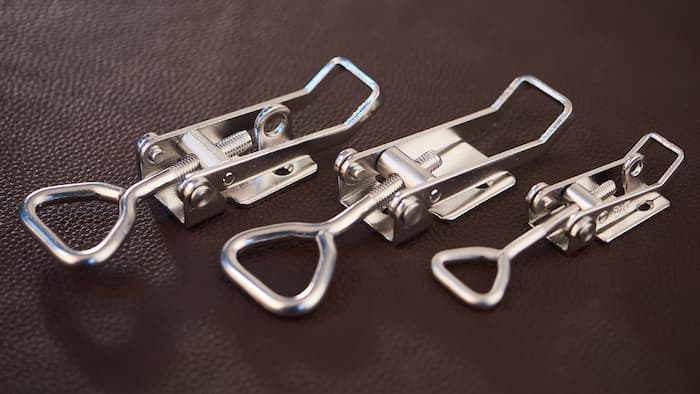
Toggle-style, draw-type latches are standouts in this category, and are highly lauded for their combination of low cost, high strength and maintenance-free operation. In their heaviest duty iterations, they’re capable of delivering clamping forces up to 7000kg UTS – the equivalent of holding 3-4 standard sized automobiles. And when secured by a shrouded/hardened steel padlock, they produce one of the most formidable fastening solutions imaginable.
Unlike standard locking systems where doors simply intersect their supporting frame, the two-part hook and clamp design of toggle-style industrial door latches is the key to their robustness. Engaging the clamp over the hook effectively draws the door solidly against the mating surface, making it a fastener that offers the following:
- Unmatched tensile strength. Tensile strength – the ability to resist a pulling or stretching force – is the most important attribute of any latch. Industrial latches are renowned for their unmatched tensile strength which, in the case of most draw-style variants, means that they can be manually adjusted to increase their clamping force by as much as ten-fold.
- An extensive latch variety. While draw-type industrial latches are the mechanical fasteners of choice for the heaviest duty jobs, there are still more than 30 other types of pull-ring/T-handle latches, slide latches and burst (rotary) latches available to cover a full range of jobs that need to be able to resist high loads and vibration.
- Incredible material strength and versatility. Rust and corrosion resistant, high nickel 304- and 316-grade stainless steels are the preferred materials for most door latch fasteners. Businesses can also buy latches made of tough, UV-resistant polymers for applications that need electrical insulation, or extra noise or vibration reduction.
Industrial latches and catches also don’t need to be encased. They don’t require door morticing or any type of clearance that could potentially weaken the frame, and can be screwed, riveted or welded to any flat surface without sacrificing any of its clamping force or stability.
Industrial Latches Boast Built-in Strength For Maximum Security
Make no mistake: while the raised profile of industrial latches might seem to exclude them from being considered secure fastening solutions, nothing could be further from the truth. The pulling action of draw-style door latches and catches that allows them to excel at sealing out dust and moisture also makes them exceptionally resilient to deliberate prying or spreading.
Even without a padlock or integrated keylock, the amount of brute force needed to muscle an industrial latch open after it’s engaged still needs to substantially exceed the amount of clamping force applied by the lock itself. It’s what makes industrial latches virtually impossible to break open without destroying the mounting surface, and why they’re so widely used for applications that require maximum security, including:
- Protection and storage of immovable installations and equipment that only require periodic access;
- Protection, storage and transport of materials that require specialised containment; and,
- Transport and storage solutions where there’s a possibility of tampering or excessive vibration.
For telcos, energy companies, and industrial and transportation companies, the built-in strength and security afforded by industrial latches is as important as base affordability is for tradies and ute owners looking to buy door latch assemblies on a budget. Cost efficiency, however, isn’t an advantage that only individuals and micro-businesses can take advantage.
The opportunity to purchase industrial latches online is one of the most crucial factors helping keep industrial latch acquisition costs down. And with their easy and straightforward mounting requirements, the cost for any size business, shipper or tradie to buy latch assemblies and quickly deploy them is minimal.
Areas to Check Before Mounting An Industrial Latch
Although strength and security are the keys to industrial latch effectiveness, it’s important to remember that the assemblies themselves are still only as reliable as where, and how they’re mounted. Everything matters, from the weight of the door and the reliability of its hinges, to the type and thickness of the mating surface affects the amount of clamping force that can be applied. That’s why each of the following points needs to be confirmed before mounting any type of latch.
- The condition of the door and the mating surface. While metal doors and mounting surfaces typically don’t pose a problem when mounting, wooden and masonry surfaces can degrade to the extend that mounting can be problematic. Latch installers need to confirm beforehand whether the door and the mating surface are strong enough to withstand the amount of clamping force that’s going to be applied.
- The state of the door’s hardware. Precise alignment between the latch and the catch are important for industrial locks, especially where airtight and watertight seals are needed. And because worn or binding door hinges, or loose or missing hinge screws or throughbolts can cause doors to sag, lift or not align correctly, installers need to be sure that all hinge hardware and their mounting surfaces are fully serviceable.
- The suitability of the latch for the job. Not every type of latch is suitable for every type of job – and simply increasing the number of latches won’t improve the seal if the solution itself isn’t sufficient. Installers have to ensure that their choice of latch is sufficiently engineered and rated for the desired fastening task, and that they avoid the mistake of using more latches than are absolutely necessary.
The fact is, the amount of tension created by industrial latches can cause permanent damage to both doors and mating surfaces if they aren’t sturdy enough, with the worst scenario resulting in a latch violently failing or blowing out. The stakes can be high, especially when there’s vibration; that underlines how important it is to verify the reliability of any areas that would be impacted by the latch.
The Final Word
At the end of the day, in an environment that’s consumed with bigger, and more technologically advanced fastening solutions, bare-knuckled industrial-grade door latch hardware is still more than capable of holding their own. And make no mistake: they’re still the gold standard when it comes to creating and maintaining seals.
Regardless of whether it’s to secure shop toolboxes from pilferage or to protect outdoor energy storage cabinets from the elements, industrial-grade door latches are the right choice. They’re the low-tech security and fastening solution that deliver big results every time.